
(Image source from: Timesofindia.indiatimes.com)
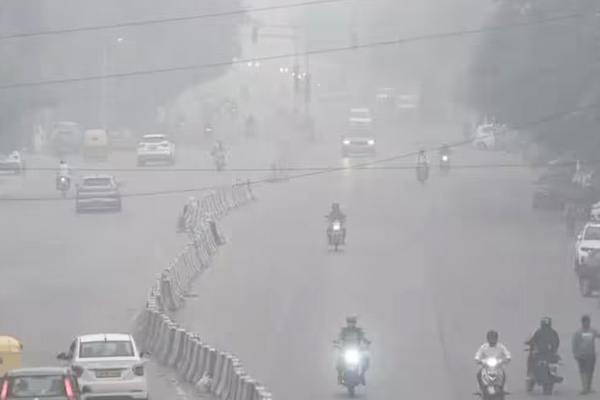
Delhi's air quality declined on Monday as the AQI approached the 'very poor' level, only a day after strong winds had temporarily improved the air from 'very poor' to 'poor' for the first time in 16 days. At 7 am, the AQI was at 298, remaining classified as 'poor' while a layer of fog and smoke covered the city, according to the Central Pollution Control Board (CPCB). On Sunday, a slight improvement in air quality was recorded, with the AQI dropping to 279, the second lowest for November after a reading of 202 on November 5, according to the Sameer app developed by the CPCB. Out of the city's 39 monitoring stations, at least 22 reported 'very poor' levels. The CPCB defines an AQI of 0-50 as 'good', 51-100 as 'satisfactory', 101-200 as 'moderate', 201-300 as 'poor', 301-400 as 'very poor', and 401-500 as 'severe'.
Nehru Nagar in southern Delhi showed the highest pollution levels among local areas, with an AQI of 351, placed in the 'very poor' category. Conversely, NSIT Dwarka in the southwest recorded an AQI of 195, classified as 'moderate'. Several known pollution hotspots, such as Anand Vihar (323), Bawana (337), Burari Crossing (304), Jahangirpuri (319), Mundka (330), Punjabi Bagh (326), Shadipur (325), and Wazirpur (321), reported AQI values in the 'very poor' category. In the National Capital Region, Noida had the highest pollution levels on Monday with an AQI of 316, also in the 'very poor' range. Faridabad was the least polluted city in the vicinity, with an AQI of 208, which is considered 'poor'. Greater Noida and Ghaziabad had AQI levels of 288 and 291, respectively, both categorized as 'poor'.
Additionally, the national capital noted its lowest average air quality index (AQI) for the January-November period since 2018, excluding the lockdown year of 2020, as reported by the Commission for Air Quality Management (CAQM) on Sunday. This year, the average AQI for that period was 187, compared to 201 in 2024, 190 in 2023, 199 in 2022, 197 in 2021, 172 in 2020, 203 in 2019, and 213 in 2018, as stated by the CAQM. During this year, only three days had a daily average AQI over 400 (the severe level), whereas there were 11 days in 2024, 12 in 2023, four in 2022, 17 in 2021, 11 in 2020, 16 in 2019, and 12 in 2018. No day this year has crossed the 450 mark, according to the statement. The PM2.5 levels for the time up to November 27 were the lowest since 2018 and similar to those in 2020. The average was 85 micrograms per cubic meter this year, compared to 98 in 2024, 90 in 2023 and 2022, 95 in 2021, 85 in 2020, 99 in 2019, and 103 in 2018.
PM10 levels were the lowest for this time of year since 2018, not counting 2020. The average this year was 183 micrograms for every cubic metre, compared to 205 in 2024, 193 in 2023, 202 in 2022, 200 in 2021, 167 in 2020, 210 in 2019, and 228 in 2018. In terms of weather, Delhi's lowest temperature was recorded at 8.3 degrees Celsius, which is 2 degrees lower than the average for this season, while the highest temperature reached 24.3 degrees Celsius, almost 2 degrees lower than the seasonal average, according to the India Meteorological Department (IMD). The IMD reported that Delhi experienced its coldest November in five years, with an average minimum temperature for the month falling to 11.5 degrees Celsius. For today, the expected maximum and minimum temperatures in the city are around 24 degrees Celsius and 8 degrees Celsius, respectively, as stated by the weather department.