
(Image source from: REUTERS)
Two powerful earthquakes struck off Venezuela's Caribbean coast on Wednesday evening, triggering panic across the country as buildings collapsed and residents rushed into the streets. The back-to-back tremors, measuring 7.2 and 7.5 on the Richter scale, were felt far beyond Venezuela's borders, prompting evacuations in parts of Brazil's Amazon region nearly 1,700 kilometers away. As concerns mounted, acting president Delcy Rodriguez announced she would address the nation. However, several hours passed without an official statement or casualty update from the government, drawing criticism from opposition leaders and anxious citizens. "The uncertainty becomes yet another layer of anguish," opposition figure Edmundo Gonzalez posted on X.
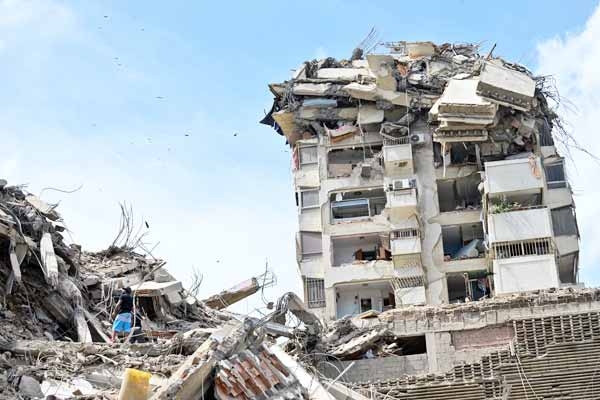
According to the U.S. Geological Survey, the first earthquake measured 7.2 in magnitude after an initial estimate of 7.1. Its epicenter was located west of Moron, a coastal town roughly 168 kilometers from Caracas, at a depth of 22 kilometers. Just one minute later, a second and even stronger 7.5-magnitude earthquake struck at a depth of 10 kilometers, with its epicenter about 16 kilometers southwest of Moron. The quakes hit shortly after 6 p.m. and are among the strongest recorded in Venezuela in more than a century. In Caracas, frightened residents evacuated swaying apartment blocks and office buildings as portions of structures collapsed. Entire walls came down in some places, exposing furniture and interiors to passersby. Thick clouds of dust rose above neighborhoods usually packed with evening crowds at restaurants and shops. Many residents remained outdoors long after sunset, afraid of additional tremors. Some sat on sidewalks clutching their pets while emergency crews assessed the damage. Fallen utility poles, debris and damaged buildings blocked roads in several areas. Power and mobile phone services were also disrupted across parts of the capital.
"It started gently, but the shaking kept growing stronger," Caracas resident Hector Ricci recalled. "Eventually everyone had to leave their homes and gather outside." For many Venezuelans, the loss of cellphone connectivity added another layer of anxiety, especially for families separated by the country's prolonged economic and political crisis, which has forced more than 7.7 million people to leave the nation over the years. Opposition leader Maria Corina Machado, who is currently living in exile, called for unity and calm. "May strength, serenity, and solidarity prevail among us in the face of this difficult time," she wrote on X. Interior Minister Diosdado Cabello confirmed that the earthquakes were felt across several states and said authorities were responding to reports of serious damage. He described the situation in Caracas' Altamira district as particularly concerning, with collapsed homes and buildings raising fears of injuries. Cabello urged motorists to clear roads for ambulances and emergency personnel.
"We understand that some people may be desperate, but we are following established protocols to activate aid and rescue operations," Cabello said during a state television broadcast. He also advised residents to remain outdoors whenever possible, warning that aftershocks could further weaken already damaged structures. Special attention, he said, should be paid to children and elderly family members as authorities continued rescue and assessment efforts. For many residents, the experience was terrifying. "The building was moving violently from side to side," said Caracas resident Roberto Gamas. "It felt unreal. The force was incredibly strong. We were walking and could barely keep our balance. Everything inside the apartment fell over. Thankfully, we managed to get out safely."
Messages of support quickly poured in from political leaders and public figures across the region. Machado again appealed for solidarity among Venezuelans, while El Salvador President Nayib Bukele expressed his country's support. "Our heart is with the people of Venezuela during these difficult times," he wrote. "We send you all our solidarity and our prayers. Stay strong, Venezuela." U.S. Representative Maria Elvira Salazar of Florida also offered support to affected families, emergency responders and those awaiting news of loved ones. She praised the resilience of Venezuelans, saying they had repeatedly overcome difficult challenges throughout recent years. The earthquakes were felt beyond Venezuela as well. In Brazil, authorities evacuated buildings in the Amazonian cities of Manaus, Belem and Macapa after tremors were detected. The shaking also reached Colombia's Caribbean and northeastern regions. While there were no immediate reports of injuries or major damage there, officials closely monitored the situation. Colombia's Maritime Authority later stated that the country's Caribbean coast faced no tsunami threat.
Tsunami alerts were briefly issued elsewhere in the region. The U.S. Pacific Tsunami Warning Center released an alert covering the Virgin Islands, while authorities in the Dominican Republic also issued a warning. A similar alert for Puerto Rico was later withdrawn after further assessment. Although Venezuela lies near several geological fault systems, major earthquakes are relatively uncommon compared to other parts of Latin America. The country sits between the South American and Caribbean tectonic plates, a location that produces seismic activity but generally not at the frequency seen along the Pacific coast. Countries such as Mexico and Chile experience far more frequent earthquakes because they lie along the highly active Pacific Ring of Fire, a tectonic belt responsible for roughly 90 percent of the world's earthquakes, according to the USGS. As emergency crews continued evaluating the damage late into the night, authorities in Venezuela and neighboring countries remained on alert for possible aftershocks.